Stock Alerts Across Splits, Dividends and Trading Halts
Preserve security identity and order state when corporate actions or market interruptions make an old alert ambiguous.
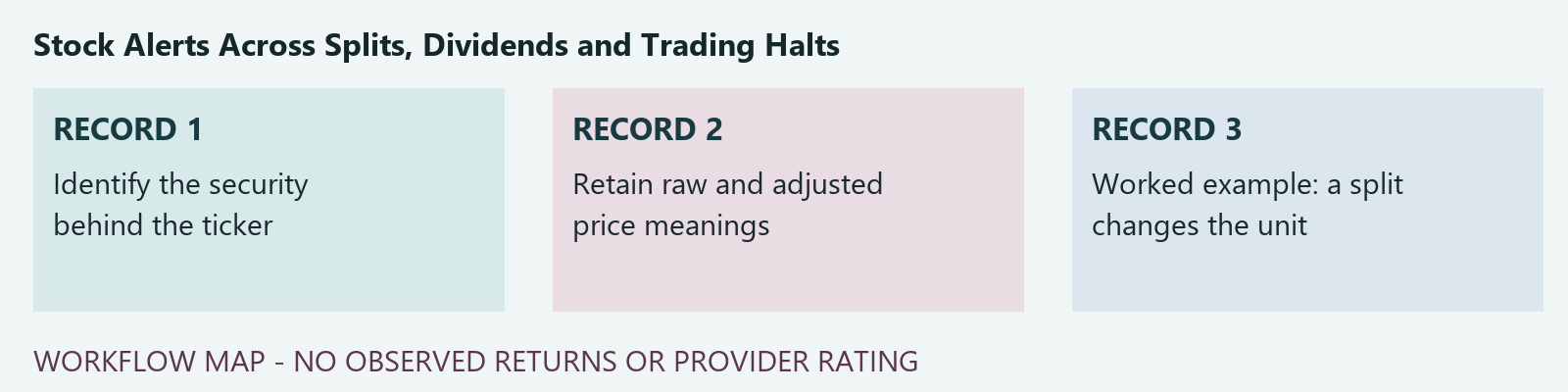
Identify the security behind the ticker
A ticker is a convenient label, not a permanent identity. Record exchange, security identifier where available, share class, currency and the date for which the symbol mapping applies. Renames, mergers and multiple listings can make a reused symbol misleading. A provider call should name the actual security and venue, while a broker order should retain its own instrument reference. Do not infer that two similarly named symbols describe the same exposure or that a historical chart uses the same current share basis.
Retain raw and adjusted price meanings
Write whether a price series is raw, split-adjusted or otherwise adjusted and what its timestamps represent. An adjusted historical level can be useful for analysis without being the price a broker displayed at the time. Preserve the original alert level and the corporate-action record separately. Do not silently replace an old instruction with a recalculated level merely to make a chart comparison look consistent. The signal author's amendment and the broker's treatment of existing orders remain independent questions.
Worked example: a split changes the unit
Invent a stock alert quoting 100 shares at 40 units before a hypothetical two-for-one split. The simple share-basis translation is 200 shares at 20 units, preserving a 4,000-unit notional before other changes. That does not prove an open order was adjusted, accepted or filled by a broker. The exercise only reconciles units. Retain the original quantity, revised quantity, action date and actual order response. An untouched old order or a separately revised provider call must be investigated rather than assumed to follow the arithmetic automatically.
Do not treat a halt as a normal missed entry
A halted security can leave the subscriber unable to open or close under the planned conditions. Record the interruption, its source and the order status reported by the broker. A price printed before the halt cannot establish a fill during it. After reopening, a gap can invalidate the original decision window or change intended stop risk. SEC order documentation provides the general boundary between an instruction and its execution, but venue and broker notices are required for a specific interruption.
Keep dividends and cash flows separate
Identify whether the reported return includes dividends, withholding, fees and currency conversion. A price-only signal result and a total account result are different objects. Ex-dividend price changes should not be retrospectively classified as ordinary strategy movement without a declared convention. Ask how the provider handles alerts spanning the event and whether open orders require review. Do not invent a universal adjustment policy or a current payout figure; retain the dated primary corporate-action and account records instead.
Close the identity and execution file
Reconcile each alert to the security mapping used at publication, every subsequent action and the broker-side order trail. Keep cancelled, rejected, partially filled and unresolved orders visible. The comparison should explain what a reader could establish from the records and what still depends on missing evidence. This chapter does not claim tested stock-provider performance or automatic correction by a particular broker. A useful stock-alert review resolves the share and cash units before calculating an outcome, rather than trusting the prettiest version of a historical chart.
Decision record
| Question | Record to retain | Decision boundary |
|---|---|---|
| Security | Exchange, share class and dated identity mapping | Ticker matching alone can join different instruments |
| Price basis | Raw level, adjustment convention and source | An adjusted chart is not an original fill record |
| Corporate action | Official event plus broker order response | Notional arithmetic does not prove order adjustment |
| Interruption | Halt or reopening notice and order state | A last price is not execution during a halt |
Blank working record
The worksheet contains column headings only. Enter your own dated observations, keep absent evidence marked unknown, and do not treat the file as certification.
 Download worksheet (CSV)
Primary references
These documents support mechanisms and source definitions, not a tested trading result or a recommendation. Accessed 9 October 2026. The decision workflow and invented examples above are editorial exercises.
Keep reading
Publication methodology | Working glossary | Source and correction policy
Order-state evidence alongside the transformation
The original corporate-action checklist is retained. A translated chart series does not show how a broker treated a resting order or an account fraction. Keep the event notice, original instruction, quantity conversion and actual acknowledgement as separate references. A cash-in-lieu event needs its supplied ledger amount rather than an assumed round-share treatment.
Fictional 75 shares at 24 undergo a declared one-for-three reverse split. Exact translated quantity is 25 and reference entry is 72; both notionals equal 1,800. An exit of 25 at 69 loses 75 before costs. Comparing the new 69 price directly with the old 24 entry would claim a fictitious gain. This arithmetic assumes the specified exact ratio and no cash settlement.